Showing posts with label www - InformationClearingHouse. Show all posts

Thursday, 22 January 2015

Asset Ownership and Our System of Deepening Debt-Serfdom

Source: informationclearinghouse


Debt-serfs who make the difficult and risky transition to small-scale business owners find they have simply moved to another class of serfdom.

By Charles Hugh Smith


January 21, 2015 "ICH" - "Of Two Minds" -    The core dynamic of debt-serfdom is that debt-serfs must borrow money to buy essentials while the wealthy borrow to invest in productive assets.

This is not merely a random result of free-market capitalism; it is the structure of cartel-capitalism in which highly profitable goods and services must be paid for with highly profitable debt.

This need to borrow to pay for essentials is already evident in student loans, vehicles and housing.

The cost of these essentials is so high that few debt-serfs can borrow enough to pay for these essentials and then have enough borrowing power left to buy productive assets.

Those few who do attempt to buy productive assets face regulatory hurdles and costs that limit their ability to own or launch small-scale profitable enterprises.
The net result is a system in which the vast majority of productive assets are owned by the few who then have the means to exploit the many.

This core dynamic of cartel capitalism is not new, as longtime correspondent Bart D. recently observed. This was the core dynamic at the root of Ireland's catastrophic potato famine of the 1840s: wealthy English owned the productive assets (land) and limited the opportunities for enterprises that boosted Irish self-sufficiency and competed with the assets owned by English financiers and landed gentry.

Here is Bart's commentary:

"I recently picked up a copy of a novel dealing with the topic of the Irish Potato famine of 1845-6 from a second hand book store run by charity. Author is Liam O’Flaherty and it was written in 1937. It was re-released in 2002. My edition was printed in the 1970’s, so it’s had a following over the years.
FamineI recommend this book HIGHLY as an insight into how families, communities, governments and economics will/are functioning in impoverished situations now and in the future. I know this because I was astonished (not using that word lightly here) at the similarity in the description of life and government/business portrayed in O’Flaherty’s book in 1845 and that which I have observed closely over many years in remote Australian Aboriginal communities from 1994 to 2012.
Especially fascinating to learn that the English Government provided ‘relief’ loans to Ireland at market interest with a condition that they could not be used to do anything productive. Basically they set up a scheme to pay a small proportion of each community to build roads, but not a cent could be spent on developing alternate Irish-owned industries or businesses for fear it would upset the rich English industrialists.
The English imported cheap American corn meal which everyone was forced to buy with the English Gov. financed wages (closing the loop of giving with one hand, taking with the other and adding in a profit to boot) after the Irish had to export all their own grain and livestock to England to pay the land rents.
The model of resource ownership described in the novel--English landlords owned all the Irish peasant farmer land and set rent at a level that ensured the farmers remained a hairs breadth ahead of destitution even under the best of circumstances--will be, I think, what our own future will look like. Unfortunately".
It’s very well written and engaging for the reader, but hard to read because of its infuriating and tragic subject material. No happy endings here.

One branch of my family (Scots-Irish, County Down) immigrated to the U.S. in the late 1840s, undoubtedly as a result of the potato famine. This history of exploitation and financial tyranny is not entirely abstract to me, and neither is the current American variation of the debt-serf model.

Those of us with experience in starting and operating small enterprises know that dozens of restrictive regulations and administrative costs limit debt-serfs' attempts to invest in small-scale productive ventures. We also know that the Federal Reserve's free funds for financiers enables hedge funds to invest $500 million in the latest software fad, while small-scale entrepreneurs have no equivalent conduit to near-zero cost funding.

Globalized cartels eliminate local pricing power by importing cheap goods from somewhere else. In less globalized circumstances, local producers retain some pricing power (and thus some profitability) because they can produce goods without the cost of shipping from overseas.

But the power of cartels buying millions of units at a time and the low cost of container shipping means cartels can eliminate the pricing power of local small-scale producers virtually everywhere.

Even low-income regions in developing nations cannot compete with global cartels in manufactured goods and agricultural/meat produce.

This is not a random result of free enterprise; it is the direct result of central banks' free funds for financiers that lowers the costs of borrowing and thus production for cartels.

Debt-serfs may legally start home businesses in some locales, but as soon as they become successful enough to compete with vested interests, their fixed costs are increased by regulatory and administrative rules. The resulting erosion of profitability and the lack of access to cheap credit limit their ability to expand without taking on burdensome levels of costly debt or selling their souls to vulture capitalists.

At that point, debt-serfs who make the difficult and risky transition to small-scale business owners find they have simply moved to another class of serfdom, one in which the serfs own an enterprise but cannot expand their capital. As a result, small enterprise ends up being just another version of serfdom, i.e. barely getting by or borrowing more just to survive.

Consider the evidence of the erosion of American small business: Economic Death Spiral: More American Businesses Dying Than Starting.


The net result is a system in which the vast majority of productive assets are owned by the few who then have the means to exploit the many.
Tuesday, 6 January 2015

The Geopolitics and Economics of the Oil Price

Source: informationclearinghouse


By Mike Whitney
“If undercharging for energy products occurs deliberately, it also affects those who introduce these limitations. Problems will arise and grow, worsening the situation not only for Russia but also for our partners.” - Russian President Vladimir Putin
January 06, 2015 "ICH" - "Counterpunch" - It’s hard to know which country is going to suffer the most from falling oil prices. Up to now, of course, Russia, Iran and Venezuela have taken the biggest hit, but that will probably change as time goes on. What the Obama administration should be worried about is the second-order effects that will eventually show up in terms of higher unemployment, market volatility, and wobbly bank balance sheets. That’s where the real damage is going to crop up because that’s where red ink and bad loans can metastasize into a full-blown financial crisis. Check out this blurb from Nick Cunningham at Oilprice.com and you’ll see what I mean:
“According to an assessment from the Federal Reserve Bank of Dallas, an estimated 250,000 jobs across eight U.S. states could be lost in 2015 if oil prices don’t rise. More than 50 percent of those job losses would occur in Texas, which leads the nation in oil production.
There are some early signs that a slowdown in drilling could spread to the manufacturing sector in Texas… One executive at a metal manufacturing company said in the survey, “the drop in crude oil prices is going to make things ugly… quickly.” Another company that manufactures machinery told the Dallas Fed, “Low oil prices will drive reductions in U.S. drilling rigs, which will in turn reduce the market for our products.”
The sentiment was similar for a chemical manufacturer, who said “lower oil prices will adversely impact margins. Energy volatility will cause our customers to keep inventories tight.”
States like Texas, North Dakota, Oklahoma, and Louisiana have seen their economies boom over the last few years as oil production surged. But the sector is now deflating, leaving gashes in employment rolls and state budgets.” (Low Prices Lead To Layoffs In The Oil Patch, Nick Cunningham, Oilprice.com)
Of course industries lay-off workers all the time and it doesn’t always lead to a financial crisis. But unemployment is just one part of the picture, lower personal consumption is another. Take a look:
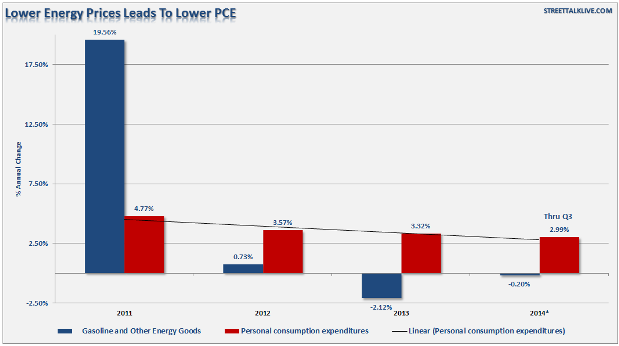
“Falling oil prices are a bigger drag on economic growth than the incremental “savings” received by the consumer…..Another way to show this graphically is to look at the annual changes in Personal Consumption Expenditures (PCE) in aggregate as compared to the subsection of PCE spent on energy and related products. This is shown in the chart below.
Lower Energy Prices To Lower PCE (Personal Consumption Expenditures):
unnamed
(The Gasoline Price Myth, Lance Roberts, oilprice.com)

See? So despite what you might have read in the MSM, lower gas prices do not translate into greater personal consumption or more robust growth. Quite the contrary, they tend to intensify deflationary pressures and reduce activity which is a damper on growth.

Then there’s the knock-on effects that crashing prices and layoffs have on other industries like mining, manufacturing and chemical production. Here’s more from Oil Price:
“Oil and gas production make up a hefty chunk of the “mining and manufacturing” component of the employment rolls. Since 2000, when the oil price boom gained traction, Texas has comprised more than 40% of all jobs in the country, according to first quarter data from the Dallas Federal Reserve…
The majority of the jobs “created” since the financial crisis have been lower wage paying jobs in retail, healthcare and other service sectors of the economy. Conversely, the jobs created within the energy space are some of the highest wage paying opportunities available in engineering, technology, accounting, legal, etc. In fact, each job created in energy related areas has had a “ripple effect” of creating 2.8 jobs elsewhere in the economy from piping to coatings, trucking and transportation, restaurants and retail….
The obvious ramification of the plunge in oil prices is that eventually the loss of revenue will lead to cuts in production, declines in capital expenditure plans (which comprise almost 1/4th of all capex expenditures in the S&P 500), freezes and/or reductions in employment, and declines in revenue and profitability…
Simply put, lower oil and gasoline prices may have a bigger detraction on the economy than the “savings” provided to consumers.” (The Gasoline Price Myth, Lance Roberts, oilprice.com)
None of this sounds very reassuring, does it? And yet, all we hear from the media is how the economy is going to reach “escape velocity” on the back of cheap oil. Nonsense. This is just more “green shoots” baloney wrapped in public relations hype. The fact is, the economy needs the good-paying jobs more than it needs low-priced energy. But now that prices are tumbling, those jobs are going to disappear, which is going to be a drag on growth. Now check out these headlines I picked up on Google News that help to show what’s going on off the radar:
“Texas is in danger of a recession”, CNN Money.
“Texas Could Be Headed for an Oil-Fueled Recession, JP Morgan Economist Says”, Wall Street Journal “Good Times From Texas to North Dakota May Turn Bad on Oil-Price Drop”, Bloomberg
“Low Oil Prices in the New Year Are Screwing Petrostates”, Vice News
“Top US Oil States Are Taking A Hit From Plunging Crude Prices”, Business Insider
Get the picture? If oil prices continue to fall, unemployment is going to spike, activity is going to slow, and the economy is going to tank. And the damage won’t be limited to the US either. Get a load of this from the UK Telegraph:
“A third of Britain’s listed oil and gas companies are in danger of running out of working capital and even going bankrupt amid a slump in the value of crude, according to new research.
Financial risk management group Company Watch believes that 70pc of the UK’s publicly listed oil exploration and production companies are now unprofitable, racking up significant losses in the region of £1.8bn.
Such is the extent of the financial pressure now bearing down on highly leveraged drillers in the UK that Company Watch estimates that a third of the 126 quoted oil and gas companies on AIM and the London Stock Exchange are generating no revenues.
The findings are the latest warning to hit the oil and gas industry since a slump in the price of crude accelerated in November when the Organisation of Petroleum Exporting Countries (OPEC) decided to keep its output levels unchanged. The decision has caused carnage in oil markets with a barrel of Brent crude falling 45pc since June to around $60 per barrel.” (Third of listed UK oil and gas drillers face bankruptcy, Telegraph)
“Carnage in oil markets,” you say?

Indeed. Many of the oil-drilling newcomers set up shop to take advantage of the low rates and easy money available in the bond market. Now that prices have crashed, investors are avoiding energy-related junk bonds like the plague which is making it impossible for the smaller companies to roll over their debt or attract fresh capital. When these companies start to default en masse, as they certainly will if prices don’t rebound, the blowback will be felt on bank balance sheets across the country creating the possibility of another financial meltdown. (Now we ARE talking about a financial crisis.)

The basic problem is that the banks have bundled a lot of their dodgy debt into financially-engineered products like Collateralized Loan Obligations (CLOs) and Collateralized Debt Obligations (CDOs) that will inevitably fail when borrowers are no longer able to service the loans. The rot can be concealed for a while, but eventually, if prices don’t recover, a significant number of these companies are going to go under, which will push the perennially-undercapitalized banking system to the brink once again. That’s why Washington’s plan to push down oil prices (to hurt the Russian economy) might have made sense on a short-term basis (to shock Putin into submission) but as a long-term strategy, it’s nuts. And what’s even crazier, is that Obama has decided to double-down on the same wacky plan even though Putin hasn’t given an inch. Check this out from Reuters on Monday:
“The Obama administration has opened a new front in the global battle for oil market share, effectively clearing the way for the shipment of as much as a million barrels per day of ultra-light U.S. crude to the rest of the world…
The Department of Commerce on Tuesday ended a year-long silence on a contentious, four-decade ban on oil exports, saying it had begun approving a backlog of requests to sell processed light oil abroad.
The action comes at a critical juncture for the global oil market. World prices have halved to less than $60 a barrel since the summer as top exporter Saudi Arabia, once a staunch defender of $100 oil, refused to cut production in the face of surging U.S. shale output and tempered global demand…
With global oil markets in flux, it is far from clear how much U.S. condensate will find a market overseas.”
(Analysis – U.S. opening of oil export tap widens battle for global market, Reuters)
Does that make sense to you, dear reader? Why would Obama suddenly opt to change the rules of the game when he knows it will increase supply and push prices down even further? Why would he do that? Certainly, he doesn’t want to inflict more pain on domestic producers, does he?

Let’s let Obama answer the question for himself. Here’s a clip from an NPR interview with the president just last week. About halfway through the interview, NPR’s Steve Inskeep asks Obama: “Are you just lucky that the price of oil went down and therefore their currency collapsed oris it something that you did?"

Barack Obama: "If you’ll recall, their (Russia) economy was already contracting and capital was fleeing even before oil collapsed. And part of our rationale in this process was that the only thing keeping that economy afloat was the price of oil. And if, in fact, we were steady in applying sanction pressure, which we have been, that over time it would make the economy of Russia sufficiently vulnerable that if and when there were disruptions with respect to the price of oil — which, inevitably, there are going to be sometime, if not this year then next year or the year after — that they’d have enormous difficulty managing it.” (Transcript: President Obama’s Full NPR Interview)

Am I mistaken or did Obama just admit that he wanted “disruptions” in the “price of oil” because he figured Putin would have “enormous difficulty managing it”?

Isn’t that the same as saying that it was all part of Washington’s plan; that plunging prices were just the icing on the cake for their asymmetrical attack on the Russian economy? It sure sounds like it. And that would also explain why Obama decided to allow domestic producers to dump more oil on the market even though it’s going to send prices lower. Apparently, none of that matters as long as the policy hurts Russia.

So maybe the US-Saudi oil collusion theory isn’t so far fetched after all. Maybe Salon’s Patrick L. Smith was right when he said:
“Less than a week after the Minsk Protocol was signed, Kerry made a little-noted trip to Jeddah to see King Abdullah at his summer residence. When it was reported at all, this was put across as part of Kerry’s campaign to secure Arab support in the fight against the Islamic State.
Stop right there. That is not all there was to the visit, my trustworthy sources tell me. The other half of the visit had to do with Washington’s unabated desire to ruin the Russian economy. To do this, Kerry told the Saudis 1) to raise production and 2) to cut its crude price. Keep in mind these pertinent numbers: The Saudis produce a barrel of oil for less than $30 as break-even in the national budget; the Russians need $105.
Shortly after Kerry’s visit, the Saudis began increasing production, sure enough — by more than 100,000 barrels daily during the rest of September, more apparently to come…
Think about this. Winter is coming, there are serious production outages now in Iraq, Nigeria, Venezuela and Libya, other OPEC members are screaming for relief, and the Saudis make back-to-back moves certain to push falling prices still lower? You do the math, with Kerry’s unreported itinerary in mind, and to help you along I offer this from an extremely well-positioned source in the commodities markets: “There are very big hands pushing oil into global supply now,” this source wrote in an e-mail note the other day.” (“What Really Happened in Beijing: Putin, Obama, Xi And The Back Story The Media Won’t Tell You”, Patrick L. Smith, Salon)
Vladimir Putin: Public Enemy Number 1

Let’s cut to the chase: All these oil shenanigans are really aimed at just one man: Vladimir Putin. There are a number of reasons why Washington wants to get rid of Putin, the first of which is that the Russian president has become an obstacle to US plans to pivot to Asia. That’s the main issue. As long as Putin is calling the shots, there’s going to be growing resistance to NATO’s push eastward and Washington’s military expansion across Central Asia, which could undermine US plans to encircle China and remain the world’s only superpower. Here’s an excerpt from Zbigniew Brzezinski’s The Grand Chessboard, which helps to explain the importance Eurasia is in terms of Washington’s global ambitions:
“..how America ‘manages’ Eurasia is critical. A power that dominates Eurasia would control two of the world’s three most advanced and economically productive regions. A mere glance at the map also suggests that control over Eurasia would almost automatically entail Africa’s subordination, rendering the Western Hemisphere and Oceania (Australia) geopolitically peripheral to the world’s central continent. About 75 per cent of the world’s people live in Eurasia, and most of the world’s physical wealth is there as well, both in its enterprises and underneath its soil. Eurasia accounts for about three-fourths of the world’s known energy resources.” (p.31) (Zbigniew Brzezinski, The Grand Chessboard: American Primacy And It’s Geostrategic Imperatives, Key Quotes From Zbigniew Brzezinksi’s Seminal Book)
Get it? Prevailing in Asia is the administration’s top priority, which is why the US is rapidly moving its military assets into place. Check this out from the World Socialist Web Site:
“Under Obama’s “pivot to Asia,” the Pacific Command will account for more than 60 percent of all US military forces, up from 50 percent under the Bush administration. This includes new US basing arrangements in the Philippines, Singapore and Australia, as well as renewed close military ties to New Zealand, and ongoing US military exercises in Thailand, Malaysia, Indonesia and Taiwan….(as well as) large troop deployments in Japan and South Korea, including nuclear-armed units.” (The global scale of US militarism, Patrick Martin, World Socialist Web Site)
The “Big Shift” is already underway, which is why obstacles have to be removed and Putin’s got to go.

Second, Putin has made himself a general nuisance vis a vis US strategic objectives in Syria, Iran and Ukraine. In Syria, Putin has thrown his support behind Assad, who the US wants to topple in order to redraw the map of the Middle East and build gas pipelines from Qatar to Turkey to access the lucrative EU market.

Third, Putin has strengthened a number of coalitions and alliances –the BRICS bank, the Eurasian Economic Union, and the Shanghai Cooperation Organization–all of which pose a challenge to US dominance in the region as well as a viable alternative to neoliberal financial institutions like the IMF and World Bank. Going back to Brzezinski’s “chessboard” once again, we see that the US should not feel threatened by any one nation, but should be constantly on-the-lookout for “regional coalitions” which could derail its plans to rule the world. Here’s Brzezinski again:
the three grand imperatives of imperial geostrategy are to prevent collusion and maintain security dependence among the vassals, to keep tributaries pliant and protected, and to keep the barbarians from coming together.” (p.40)
“Henceforth, the United States may have to determine how to cope with regional coalitions that seek to push America out of Eurasia, thereby threatening America’s status as a global power.” (p.55) (Zbigniew Brzezinski, The Grand Chessboard: American Primacy And It’s Geostrategic Imperatives, Key Quotes From Zbigniew Brzezinksi’s Seminal Book)
As a founding member and primary backer of these organizations, (and initiator of giant energy deals with China, India and Turkey) Putin has become Washington’s biggest headache and a logical target for regime change.

Finally, Putin is doing whatever he can to circumvent dollar-denominated business and financial transactions. The move away from the buck is a direct attack on the US’s greatest source of power, the ability to control the de facto international currency and to require that other nation’s stockpile dollars for their energy purchases which are then recycled into US financial assets, stocks bonds and US Treasuries. This petrodollar-recycling scam allows the US to run gigantic current account deficits without raising interest rates or reducing government spending. Putin’s anti-dollar policies could diminish the greenback’s role as reserve currency and put an end to a system that institutionalizes looting.

This is why Putin is Public Enemy Number 1. It’s because he’s blocking the US pivot to Asia, strengthening anti-Washington coalitions, sabotaging US foreign policy objectives in the Middle East, creating institutions that rival the IMF and World Bank, transacting massive energy deals with critical US allies, increasing membership in an integrated, single-market Eurasian Economic Union, and attacking the structural foundation upon which the entire US empire rests, the dollar.

Naturally, Washington’s power brokers are worried about these developments, just as they are worried about the new world order which is gradually taking shape under Putin’s guidance. But, so far, they haven’t been able to do anything about it. The administration’s regime change schemers and fantasists have shown time-and-again that they’re no match for Bad Vlad who has beaten them at every turn.

Saturday, 3 January 2015

History Lesson: America Is the Same Oligarchy It Was over a Century Ago

Source: informationclearinghouse


By Aaron Dykes and Melissa Melton

January 02, 2015 "ICH" - (Truthstream Media) When Americans see charts like this one (as above) which illustrate that virtually all the food on grocery store shelves basically comes from no more than 10 megacompanies, or hear statements like this one from our own Attorney General Eric Holder, who told the Senate Judiciary Committee that some banks are just too big to prosecute, or check out studies like this one out of Princeton which openly declare we are not a democracy but an oligarchy… it’s kinda hard to believe we aren’t an oligarchy (because we are).

Come on, even our Federal Reserve Chair Janet Yellen (you know, the lady that runs the place that prints our money and sells it to us with interest) has basically admitted it.

But are things really getting worse these days or is this just par for the course — the same course we’ve been on for over a century now?

Tinkering around in an old bookstore in a small Texas town, we came across a set of old books on democracy; we got the first seven volumes of a set entitled, The March of Democracy: A History of the United States written by James Truslow Adams — the guy who coined the term “The American Dream”— for a mere $20.


marchofdemocracy

The first book’s copyright is 1932. The last book ends in 1958.
Fascinating stuff…

For example, in volume four “America and World Power,” the book discusses how “Gradually and quite naturally, there grew up the belief in a great conspiracy on the part of the very rich to ruin the poor.”

Read this and tell me — does any of it sound even the least bit familiar to you?

Most strikingly in the public eye were the great Titans of the new business era, the coal and meat “barons” and the copper, railway, steel, and other “kings,” men of the type of the elder J.P. Morgan, of James J. Hill, William H. Vanderbilt, Carnegie, Frick, William H. Clark, and Rockefeller. Such men had certain broad traits in common, differ as they might from each other as individuals. They were men of wide economic but intensely narrow social vision, and of colossal driving power and iron wills. They could lay their economic plans with imperial vision in time and space, but for the effect of their acts on society, they cared nothing whatever. They claimed the right to rule the economic destinies of the people in any way that would enure their own personal advantage. Illogically, they insisted upon the theory of laissez-faire for all except themselves, while they demanded and received every favor they wished in the way of special privileges from the government, as in the tariff and the silver purchase Act. The whole machinery of government must be at their disposal when desired — legislation, court decisions, and Federal troops. They combined their business units into “trusts” and combinations of almost unlimited power, yet they insisted on “freedom of contract” when dealing with labor, whose organization in any form they almost wholly refused to sanction.

They never taught you any of that back in school, did they?

That was written, by the way, in 1940; the author was discussing how America was run back in the late 1800s.

Not only is the emphasis on Democracy a distortion of the fact the nation was founded as a Constitutional Republic, where rights are preserved rather than subjected to the whims of the majority, but these passages demonstrate the familiar snow job surrounding the all-but-official banker’s oligarchy that has ruled this country and many others for some time.

In fact, in volume five, “The Record of 1933–1941,” Adams records the death of John D. Rockefeller, Sr., as the end of the era of this great wealth — never to occur again.

On May 23, John D. Rockefeller, Sr., died at the age of 97. Owner at one time of the largest fortune in the world, his lifespan had covered the entire history of American business from before the Civil War… Nearly $350,000,000 are handled by three of the Rockefeller Foundations for education, medical research and other uses. Whatever may be thought as to the methods of accumulating the beginnings of the fortune in a period of different business ethics and social outlook, no other man through his financial gifts has ever so widely benefited mankind. With our income and inheritance taxes, no other such fortune will ever again be accumulated, and his death marked the end of an era in American history.

And so that’s the end of the story, kids…

Everything ended happily ever after.

Well, not quite.

Despite appearances, the shift on the part of the Rockefellers and other Robber Barons of the day from outright monopoly to “philanthropic” “non-profit” charity work was not an end to the dominance by the super-rich of the early 20th Century, but an intensification of their undue influence. The taxation of the wealthy as well as the anti-trust actions of the day, which included busting up megacorpses like Standard Oil and AT&T, were perhaps well meaning but fundamentally failed to reign in the disparity of power.

Instead, new tax laws, in reality, acted to restrict new wealth from reaching the heights of the oligarchy, allowing “the elite” to keep their own, and initiate new members as desired. The tax-free status of many institutions – including the Rockefeller Foundation, the Carnegie Endowment for International Peace and the Ford Foundation – allowed the incredibly wealthy to a) shield their fortunes from taxation, b) appear to do good works and boost public opinion of their principle members while c) influencing, writing and developing official public policy through the steering mechanisms of its own tax-free grant making, think tank and research powers. Much social engineering has taken place – with far too little public notice – through these bodies. Additionally, d) many of its directors and board members were in “respectable” positions to shift into official government positions through the revolving door without appearing to be acting on behalf of their corporate masters.

The Reece Committee Hearings, conducted in 1953, attempted to probe the role of tax-free foundations in public life and uncovered many outrageous and conspiratorial actions taking place, including very apparent agendas advancing a one-world corporate-dominated government. However, it did not succeed in a general public understanding of what was taking place, nor did it reign in their powers.

Yesterday, the markets in gold, silver, oil, steel and other commodities were successfully cornered by the Rothschilds and other top bankers. Under Wall Street direction, and through the powers of the then newly-created Federal Reserve, these titans were able to officially dominate nearly all the important areas of public life, including great expansions in consumer spending and government agency powers. The icons of this magnificent and terrible wealth were John D. Rockefeller, J.P. Morgan, Andrew Carnegie, E.H. Harriman, Cornelius Vanderbilt and a handful of others.

Today, those icons of wealth are the likes of Bill Gates, Warren Buffett, Carlos Slim, Larry Ellison, the Koch Brothers, Michael Bloomberg, Steve Jobs (now deceased), the Walton family descendants of Walmart and, again, a handful of others who are largely known for their role in the age of computers, the Internet, telecommunications and electronic devices.

The real wealth, from older robber barons accumulated in land, resources, banking and investment and commodities are still there, but remain under reported on the Forbes’ list of the world’s richest, instead ruling largely from the shadows and influential but secretive groups such as Bilderberg.

The Bill & Melinda Gates Foundation, as well as the Gates-Buffett led billionaires’ “giving pledge” are keeping in stride with the groundwork laid and continued by the Rockefeller Foundation and Ford Foundation. Heavily funded initiatives to push vaccines, birth control, population control, Western-oriented “education,” GMO and corporate-dominated agriculture and the like remain some of the most consequential and troubling policies done in the name of “good” by tax-free entities wielding enormous, nearly incalculable wealth and power.

In short, the myth of “democracy” and freedom in the United States – the beacon around the world – perpetuates, despite a few blemishes. But in reality, the Oligarchy took hold some time ago, has not let up and perhaps never will.
Let that sink in, kids. Take a good look, and let it all sink in.

And don’t forget to read Charlotte Iserbyt’s revealing and TRUE work, loaded with documents and footnotes, The Deliberate Dumbing Down of America.

It helps to explain why you don’t know this stuff, why the reigns of power have been stolen from us, and why things are not soon going to get better.

Unfortunately, the late comedic genius George Carlin was all-too-right when he explained the owners of America and why the education system is broken:


Friday, 2 January 2015

Murdoch, Scaife and CIA Propaganda

Source: informationclearinghouse


Special Report: The rapid expansion of America’s right-wing media began in the 1980s as the Reagan administration coordinated foreign policy initiatives with conservative media executives, including Rupert Murdoch, and then cleared away regulatory hurdles.

By Robert Parry

December 31, 2014 "ICH" - "Consortium News" - The Reagan administration pulled right-wing media executives Rupert Murdoch and Richard Mellon Scaife into a CIA-organized “perception management” operation which aimed Cold War-style propaganda at the American people in the 1980s, according to declassified U.S. government records.

Although some records relating to Murdoch remain classified, several documents that have been released indicate that he and billionaire Scaife were considered sources of financial and other support for President Ronald Reagan’s hard-line Central American policies, including the CIA’s covert war in Nicaragua.

A driving force behind the creation of Reagan’s extraordinary propaganda bureaucracy was CIA Director William Casey, who dispatched the CIA’s top covert action specialist, Walter Raymond Jr., to the National Security Council to oversee the project. According to the documents, Murdoch was brought into the operation in 1983 – when he was still an Australian citizen and his media empire was much smaller than it is today.

Charles Wick, director of the U.S. Information Agency, arranged at least two face-to-face meetings between Murdoch and Reagan, the first on Jan. 18, 1983, when the administration was lining up private financing for its propaganda campaign, according to records at the Reagan presidential library in Simi Valley, California. That meeting also included lawyer and political operative Roy Cohn and his law partner Thomas Bolan.

The Oval Office meeting between Reagan and Murdoch came just five days after NSC Advisor William Clark noted in a Jan. 13, 1983 memo to Reagan the need for non-governmental money to advance the project. “We will develop a scenario for obtaining private funding,” Clark wrote, as cited in an unpublished draft chapter of the congressional Iran-Contra investigation.

Clark then told the President that “Charlie Wick has offered to take the lead. We may have to call on you to meet with a group of potential donors.”

The documents suggest that Murdoch was soon viewed as a source for that funding. In an Aug. 9, 1983 memo summing up the results of a Casey-organized meeting with five leading ad executives regarding how to “sell” Reagan’s aggressive policies in Central America, Raymond referred to Murdoch as if he already were helping out.

In a memo to Clark, entitled “Private Sector Support for Central American Program,” Raymond criticized a more traditional White House outreach program headed by Faith Whittlesey as “preaching to the converted.”

Raymond told Clark that the new project would involve a more comprehensive approach aimed at persuading a majority of Americans to back Reagan’s Central American policies, which included support for right-wing regimes in Guatemala and El Salvador as well as the Contra rebels fighting the leftist Sandinista government of Nicaragua.

“We must move out into the middle sector of the American public and draw them into the ‘support’ column,” Raymond wrote. “A second package of proposals deal with means to market the issue, largely considering steps utilizing public relations specialists – or similar professionals – to help transmit the message.”

To improve the project’s chances for success, Raymond wrote, “we recommended funding via Freedom House or some other structure that has credibility in the political center. Wick, via Murdoch, may be able to draw down added funds for this effort.”

Raymond included similar information in a separate memo to Wick in which Raymond noted that “via Murdock [sic] may be able to draw down added funds” to support the initiative. (Raymond later told me that he was referring to Rupert Murdoch.)

In a March 7, 1984 memo about the “‘Private Funders’ Project,” Raymond referred to Murdoch again in discussing a request for money from longtime CIA-connected journalist Brian Crozier, who was “looking for private sector funding to work on the question of ‘anti-Americanism’ overseas.”

Raymond wrote: “I am pursuaded [sic] it is a significant long term problem. It is also the kind of thing that Ruppert [sic] and Jimmy might respond positively to. Please look over the stack [of papers from Crozier] and lets [sic] discuss if and when there might be further discussion with our friends.”

Crozier, who died in 2012, had a long history of operating in the shadowy world of CIA propaganda. He was director of Forum World Features, which was set up in 1966 by the Congress for Cultural Freedom, which received covert funding from the CIA. Crozier also acknowledged in his memoir, keeping some of his best stories for the CIA.

At least one other document related to Murdoch’s work with USIA Director Wick remains classified, according to the National Archives. Murdoch’s News Corp. has not responded to requests for comment about the Reagan-era documents.

Helping Murdoch

Murdoch, who became a naturalized citizen of the United States in 1985 to meet a regulatory requirement that U.S. TV stations must be owned by Americans, benefited from his close ties to both U.S. and British officialdom.

On Monday, the UK’s Independent reported that Ed Richards, the retiring head of the British media regulatory agency Ofcom, accused British government representatives of showing favoritism to Murdoch’s companies.

Richards said he was “surprised” by the informality, closeness and frequency of contact between executives and ministers during the failed bid by Murdoch’s News Corp. for the satellite network BSkyB in 2011. The deal was abandoned when it was discovered that journalists at Murdoch’s News of the World tabloid had hacked the phone of murdered schoolgirl Milly Dowler and others.

“What surprised everyone about it – not just me – was quite how close it was and the informality of it,” Richards said, confirming what had been widely reported regarding Murdoch’s access  to powerful British politicians dating back at least to the reign of Prime Minister Margaret Thatcher in the 1980s. The Reagan documents suggest that Murdoch built similarly close ties to leading U.S. politicians in the same era.

In 1983, Murdoch’s rising media empire was still based in Australia with only a few U.S. properties, such as the Star tabloid and the New York Post. But he was eyeing expansion into the U.S. media market. In 1984, he bought a stake in 20th Century Fox and then six Metromedia television stations, which would form the nucleus of Fox Broadcasting Company, which was founded on Oct. 9, 1986.

At the time, Murdoch and other media moguls were lobbying for a relaxation of regulations from the Federal Communications Commission, a goal that Reagan shared. Under FCC Chairman Mark Fowler, the Reagan administration undertook a number of steps favorable to Murdoch’s interests, including increasing the number of TV stations that any single entity could own from seven in 1981 to 12 in 1985.

In 1987, the “Fairness Doctrine,” which required political balance in broadcasting, was eliminated, which enabled Murdoch to pioneer a more aggressive conservatism on his TV network. In the mid-1990s, Murdoch expanded his political reach by founding the neoconservative Weekly Standard in 1995 and Fox News on cable in 1996. At Fox News, Murdoch has hired scores of prominent politicians, mostly Republicans, putting them on his payroll as commentators.

Last decade, Murdoch continued to expand his reach into U.S. mass media, acquiring DirecTV and the financial news giant Dow Jones, including The Wall Street Journal, America’s leading business news journal.

Scaife’s Role

Richard Mellon Scaife exercised his media influence on behalf of Reagan and the conservative cause in a different way. While the scion of the Mellon banking, oil and aluminum fortune did publish a right-wing newspaper in Pittsburgh, the Tribune Review, Scaife mostly served as a financial benefactor for right-wing journalists and think tanks.

Indeed, Scaife was one of the original financiers of what emerged as a right-wing counter-establishment in media and academia, a longstanding goal of key Republicans, including President Richard Nixon who recognized the importance of propaganda as a political weapon.

According to Nixon’s chief of staff H.R. Haldeman, as reported in The Haldeman Diaries, one of Nixon’s pet ideas was to build a network of loyal conservatives in positions of influence. The President was “pushing again on the project of building our establishment in press, business, education, etc.,” Haldeman wrote in one entry on Sept. 12, 1970.

Financed by rich conservative foundations and wealthy special interests, Nixon’s brainchild helped tilt politics in favor of the American Right with Richard Mellon Scaife one of the project’s big-money godfathers. By using family foundations, such as Sarah Scaife and Carthage, Scaife joined with other leading right-wing foundations to fund think tanks, such as the Heritage Foundation, which Scaife helped launch in 1973.

In 1978, Nixon’s friend and Treasury Secretary William Simon provided more impetus to this growing machine, declaring in his book, Time for Truth: “Funds generated by business… must rush by the multimillion to the aid of liberty… to funnel desperately needed funds to scholars, social scientists, writers and journalists who understand the relationship between political and economic liberty.”

With Reagan’s inauguration in 1981 – and Casey’s selection as CIA director – Scaife and other right-wing ideologues were in position to merge their private funding with U.S. Government money in pursuit of the administration’s geopolitical goals, including making sure the American people would not break ranks as many did over the Vietnam War.

Building the Operation

On Nov. 4, 1982, Raymond, after his transfer from the CIA to the NSC staff, but while still a CIA officer, wrote to NSC Advisor Clark about the “Democracy Initiative and Information Programs,” stating that “Bill Casey asked me to pass on the following thought concerning your meeting with Dick Scaife, Dave Abshire [then a member of the President’s Foreign Intelligence Advisory Board], and Co.

“Casey had lunch with them today and discussed the need to get moving in the general area of supporting our friends around the world. By this definition he is including both ‘building democracy’… and helping invigorate international media programs. The DCI [Casey] is also concerned about strengthening public information organizations in the United States such as Freedom House. …

“A critical piece of the puzzle is a serious effort to raise private funds to generate momentum. Casey’s talk with Scaife and Co. suggests they would be very willing to cooperate. … Suggest that you note White House interest in private support for the Democracy initiative.”

In subsequent years, Freedom House emerged as a leading critic of Nicaragua’s Sandinista government, which Reagan and Casey were seeking to overthrow by covertly supporting the Contra rebels. Freedom House also became a major recipient of money from the U.S.-funded National Endowment for Democracy, which was founded in 1983 under the umbrella of the Casey-Raymond project.

The role of the CIA in these initiatives was concealed, but never far from the surface. A Dec. 2, 1982 note addressed to “Bud,” a reference to senior NSC official Robert “Bud” McFarlane, described a request from Raymond for a brief meeting.  “When he [Raymond] returned from Langley [CIA headquarters], he had a proposed draft letter… re $100 M Democ [racy]  Proj [act],” the note said.

While Casey pulled the strings on this project, the CIA director instructed White House officials to hide the CIA’s role. “Obviously we here [at CIA] should not get out front in the development of such an organization, nor should we appear to be a sponsor or advocate,” Casey said in one undated letter to then-White House counselor Edwin Meese III as Casey urged creation of a “National Endowment.”

On Jan. 21, 1983, Raymond updated Clark about the project, which also was reaching out to representatives from other conservative foundations, including Les Lenkowsky of Smith-Richardson, Michael Joyce of Olin and Dan McMichael of Mellon-Scaife. “This is designed to develop a broader group of people who will support parallel initiatives consistent with Administration needs and desires,” Raymond wrote.

Bashing Teresa Heinz

One example of how Scaife’s newspaper directly helped the Reagan administration can be seen in clippings from the Tribune-Review that I found in Raymond’s files. On April 21, 1983, the newspaper published a package of stories suggesting illicit left-wing connections among groups opposed to nuclear war.

The articles leave little doubt that Scaife’s newspaper is suggesting that these anti-war activists are communists or communist fellow travelers. One headline reads: “Reds Woo Some U.S. Peace Leaders.”

Another article cites an accusation from one congressman in the 1950s, after hearings on foundation grants “to numerous Communists and Communist-front organizations,” that “Here lies the story of how Communism and Socialism are financed in the U.S. – where they get their money.” The 1983 article then asks: “Is history repeating itself?”

Ironically, one of the philanthropists who is singled out in these red-baiting articles is Teresa Heinz, then married to Sen. John Heinz, R-Pennsylvania, who died in a 1991 plane crash. In 1995, Teresa Heinz married Sen. John Kerry, D-Massachusetts, who is currently Secretary of State.

The organizational role of Casey and Raymond in this domestic propaganda campaign raised concerns about the legality of having two senior CIA officials participating in a scheme to manage the perceptions of the American people.

Both in internal documents and a deposition to the congressional Iran-Contra committee, Raymond made clear his discomfort about the possible legal violation from his and Casey’s roles. Raymond formally resigned from the CIA in April 1983, so, he said, “there would be no question whatsoever of any contamination of this.”

That sensitivity was also reflected in press guidance prepared in case a reporter noted Raymond’s CIA background and the problems it presented to the “public diplomacy” effort. In case someone challenged press reports that asserted “there is no CIA involvement in the Public Diplomacy Program” and then asked “isn’t Walt Raymond, a CIA employee, involved heavily?” – the prescribed answer was:

“Walter Raymond is a member of the National Security Council staff. In the past, he has worked for Defense, CIA and State. It is true that in the formative stages of the effort, Walt Raymond contributed many useful ideas. It is ironic that he was one of those who was most insistent that there be no CIA involvement in this program in any way.

“Indeed, it is a credit to the Agency that it has stressed throughout that the United States ought to be completely open about the programs it puts in place to assist in the development of democratic institutions and that none of these programs should come under the aegis of the CIA. They do not want to be involved in managing these programs and will not be. We have nothing to hide here.”

If a reporter pressed regarding where Raymond last worked, the response was to be: “He retired from CIA. He is a permanent member of the National Security Council.” And, if pressed about Raymond’s duties, the scripted answer was: “His duties there are classified.” (Raymond’s last job at the CIA was Director of the Covert Action Staff with a specialty in propaganda and disinformation.)

Beyond how Raymond’s “classified duties” contradict the assertion that “we have nothing to hide here,” there was a more deceptive element of the press guidance: it didn’t mention the key role of CIA Director Casey in both organizing and directing the project – and it suggested that Raymond’s role had been limited to offering “many useful ideas” when he was the hands-on, day-to-day manager of the operation.

Casey’s Hidden Hand

Casey’s secret role in the propaganda scheme continued well into 1986, as Raymond continued to send progress reports to his old boss, even as Raymond fretted in one memo about the need “to get [Casey] out of the loop.”

The “public diplomacy” operation was “the kind of thing which [Casey] had a broad catholic interest in,” Raymond shrugged during his Iran-Contra deposition. He then offered the excuse that Casey undertook this apparently illegal interference in domestic politics “not so much in his CIA hat, but in his adviser to the president hat.”

Though the Casey-Raymond teamwork ended with the exposure of the Iran-Contra scandal in late 1986 and with Casey’s death on May 6, 1987, its legacy continued with Scaife and other rich right-wingers funding ideological media that protected the flanks of President Reagan, his successor President George H.W. Bush and other Republicans of that era.

For instance, Scaife helped fund the work of Steven Emerson, who played a key role in “discrediting” investigations into whether Reagan’s 1980 campaign had sabotaged President Jimmy Carter’s hostage negotiations with Iran to gain an edge in that pivotal election. [See Consortiumnews.com’s “Unmasking October Surprise Debunker.”]

Scaife also helped finance the so-called “Arkansas Project” that pushed hyped and bogus scandals to damage the presidency of Bill Clinton. [See Consortiumnews.com’s “Starr-gate: Cracks on the Right.”]

Walter Raymond Jr. died on April 16, 2003. Richard Mellon Scaife died on July 4, 2014. But Rupert Murdoch, now 83, remains one of the most powerful media figures on earth, continuing to wield unparalleled influence through his control of Fox News and his vast media empire that stretches around the globe.

Monday, 22 December 2014

Ayatollah Khamenei's 6 Reasons to Prove ISIS Serves the U.S. and Israel

Source: informationclearinghouse


Ayatollah Khamenei's 6 Reasons to Prove ISIS Serves the U.S. and Israel

December 22, 2014 "ICH" - There is an undeniable point which is the fact that the takfiri orientation and the governments which support and advocate it move completely in the direction of the goals of arrogance and Zionism. Their work is in line with the goals of America, the colonialist governments in Europe and the government of the usurping Zionist regime.

Certain signs confirm this claim. The takfiri orientation is Islamic on the face of it, but in practice, it is at the service of the great colonialist, arrogant and political orientations that are working against the world of Islam. There are clear signs which cannot be ignored. I would like to mention a few of these signs: one is that the takfiri orientation managed to make the movement of Islamic Awakening deviate from its path. The movement of Islamic Awakening was an anti-American and anti-arrogance movement which was against the elements that America had installed in the region.

It was a movement that had been launched by the masses of the people in different countries of North Africa. These countries were against arrogance and America. The takfiri orientation changed the direction of this anti-arrogance, anti-American and anti-tyranny movement. It turned it into a war between Muslims and into fratricide. The front line of fighting in the region was the borders of occupied Palestine, but the takfiri orientation came and changed this front line to the streets of Baghdad, the Jameh Mosque of Syria and Damascus, the streets of Pakistan and different cities of Syria. These places became the front line of fighting.

Take a look at the condition of today's Libya, Syria, Iraq, Pakistan and see against whom the forces and swords of Muslims are being used. These forces should have been used against the Zionist regime. The takfiri orientation changed the direction of this fighting to our homes, our cities and our Islamic countries. They cause explosions inside the Jameh Mosque of Damascus. They kill people by causing explosions in Baghdad while they are holding their ordinary rallies. In Pakistan, they fire a volley of bullets on hundreds of people. As you can witness today, they are creating such disastrous conditions in Libya. All of these are among the unforgettable and historical crimes of the takfiri orientation.

It is this orientation that has brought about this situation. This movement is at the service of arrogance. It is at the service of America and England. What they do is at the service of the intelligence services of America and England. It is at the service of Mossad and other such intelligence services.

Another sign is that those who support the takfiri orientation compromise with the Zionist regime so that it fights against Muslims. They do not even frown at the Zionist regime, but they deliver all sorts of blows to Islamic countries and nations and they hatch all sorts of plots against them.

Another sign is that the seditious movement which the takfiri orientation launched in Islamic countries - including Iraq, Syria, Libya, Lebanon and other countries - has led to the destruction of the valuable infrastructures of these countries. Notice how many roads, refineries, mines, airports, streets, cities and houses have been destroyed in these countries. Notice how long it takes and how much money is necessary for these countries to go back to their prior conditions. This has happened as a result of domestic wars and fratricide. These are the losses and the blows that the takfiri orientation has delivered to the world of Islam since a few years ago until today.

Another sign is that the takfiri orientation damaged the reputation of Islam in the world and it painted an ugly picture of it. Everyone in the world saw on TV that someone is made to sit on the ground and they behead them with a sword without charging him with any crime: "Allah forbids you not - with regard to those who fight you not for your faith nor drive you out of your homes - from dealing kindly and justly with them: for Allah loves those who are just. Allah only forbids you - with regard to those who fight you for your faith, and drive you out of your homes, and support others in driving you out - from turning to them for friendship and protection. And whoever makes friends with them, these are the unjust" [The Holy Quran, 60: 8-9].

These people did the exact opposite of this. They killed Muslims and innocent non-Muslims and the pictures were broadcast all over the world. The whole world saw this. These acts were done in the name of Islam.

Ayatollah Khamenei, 11/25/2014


http://english.khamenei.ir//index.php?option=com_content&task=view&id=1687